Why does the author think graphic novels are a good art form for secondary students?
Graphic novels are a unique way that students can interact with art. They are literally reading the artwork and becoming engaged with it. Graphic novels often times include certain themes or situations that readers can relate to. Themes of family situations and different backgrounds can appeal to students. Seeing how the characters handle life challenges could potentially help a student with personal challenges.
They also have a new way to learn about the world they live in. A graphic novel about middle eastern culture may be easier to approach than a scholarly collection of just text. The human experience becomes more tangible and less abstract.
Graphic novels can also be considered a form of contemporary art, in which allows for relationships to occur between text and imagery. In someways it might help bridge students into understanding the contemporary art world.
It is also beneficial to allow students to try out creating graphic novels. They put life into the context of an art form. Whether it is autobiographical or not, students can personally face their fears and explore their dreams.
Monday, March 26, 2018

Monday, March 19, 2018


Monday, March 12, 2018
Reading 5 Response
Figure drawing is so fundamental to the art world. It's not only a great skill to practice, but it's also a great topic to study in terms of understanding humanity. The author makes the claim that through the study of figure drawing we are analyzing concepts of relationships, identity, culture, etc. A specific example is given concerning a Korean American student who was interested in female fashion figures. After some guidance from her art teacher, she explored the reasoning behind being drawn to those kind of figures. With this in mind, she drew the fashion figures, but spray painted greek statue stencils over the top of them. Her process reflects what teachers should hope their students gain from their classroom - discovering truths about humanity.
I personally love drawing (and painting) the human figure. I could do it everyday and still be excited about it. High school provided me with some basic anatomy help. We copied the figures, skeletons, and skulls from packets. We also spent one or two days drawing each other. It was a very basic introduction. Although I enjoyed doodling up my own characters, that high school experience was not enough for me to develop a deep relationship and love for drawing and exploring the human figure. My figure drawing for illustrators class, here at BYU, was the most amazing and helpful class I have ever taken. I feel like it taught me the technique and skill that I needed to progress not only in creating the figure, but also in drawing in general. I also believe that drawing in a sketchbook consistently is important. It exercises our creativity and our ability to draw from life.I would spend more than just one or two days on figure drawing. I would include helpful homework assignments to help students master anatomy skills outside of the classroom. These homework assignments will be geared to help them feel more comfortable drawing from life in the classroom. I will vary the homework assignments between strict and lax. Some assignments might include something like "Draw ten faces," while others might be more like, "draw a personal rendition of any figure from your life." My class will also be structured so that we spend some time gesture drawing before we spend a large amount of time rendering the human figure.
Monday, March 5, 2018
Destruction of the Mandala
The first mandala on this page is the mandala to be destroyed. It's representative of the past. By destroying this mandala, I will reflect on what it means to let go of time and look ahead.
(I will edit this once I destroy the mandala soon!)


Reading 4: Mandala Articles Response
I am fascinated by the ideas of mandalas being a form of art that reflects the spiritual side of human nature. As an art, it gives so much depth to common themes or ideas already expressed by present artists as well as historically. Mandalas seem to inspire reflection about our place within the human race. Even though its tempting to focus on our individual needs or wants, studying mandalas redirects our perspective onto others.
I really admire the aspect of a journey for compassion and knowledge represented by a mandala. I feel like this is an idea that students can benefit one. I would encourage students to be mindful of this journey as they create their own mandala.
The idea of a mandala being a blueprint is vital for the concept of a journey. I would like to compare a mandala also to a map, helping individuals recenter or realign themselves with the universe that they know. I can imagine a mandala also helping individuals re-focus on maintaining a healthy way of life, whether that is spiritually, physically, emotionally, socially, etc.
I think the Buddhist ideal of selflessness is super important to our well-being. I believe that friendship and charity unites communities. A united community tends to enjoy better values, morals, and peace in general. I would like my classroom to reflect on these ideas and how the choices they make on a day-to-day basis either moves towards or away from this ideal.
I really admire the aspect of a journey for compassion and knowledge represented by a mandala. I feel like this is an idea that students can benefit one. I would encourage students to be mindful of this journey as they create their own mandala.
The idea of a mandala being a blueprint is vital for the concept of a journey. I would like to compare a mandala also to a map, helping individuals recenter or realign themselves with the universe that they know. I can imagine a mandala also helping individuals re-focus on maintaining a healthy way of life, whether that is spiritually, physically, emotionally, socially, etc.
I think the Buddhist ideal of selflessness is super important to our well-being. I believe that friendship and charity unites communities. A united community tends to enjoy better values, morals, and peace in general. I would like my classroom to reflect on these ideas and how the choices they make on a day-to-day basis either moves towards or away from this ideal.
Thursday, March 1, 2018
Response: Design Book Analysis
There's a lot of good design elements I recognized in the book I borrowed, Drawing Words & Writing Pictures by Jessica Abel & Matt Madden. First off, it has a simple and consistent color scheme. I also love how fun the cover is and used a nearly identical format:


The pages on the inside have a very clean layout. Besides black and white, you'll find simple tones of red and orange. This format stays consistent throughout the book. I appreciate the images and illustrated examples within the book, but I'm also grateful that they work with the text. The pictures are not overwhelming and I do not feel like there are too many to one page.
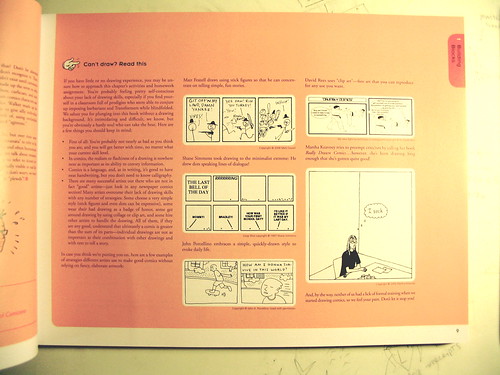
I have two things that I do not like about the book and would change:
1. I don't think the authors always used the most professional images they could find. It feel like they were just finding examples from any comics in particular instead of focusing on comics that are designed more successfully. Rather than showing examples and explaining what works and what does not work in comic design, the authors just toss in whatever copies of comics they can find and write about the basics of writing a comic. It's the like the difference between someone writing a well-written and well-thought out essay and comparing that to someone who just filled a paper with text ten minutes before it was due. Both people wrote an essay, but only one did it successfully.
2. The size of the book is so awkward! I think it is 11x17. It is weird to flip the pages on the short side instead of the long side. Also, I feel like it would be more appropriate for the book to more comic book-sized. Most comic books are easily accessible. You do not have to lay the whole thing out on a table just to flip one page.
Subscribe to:
Comments (Atom)